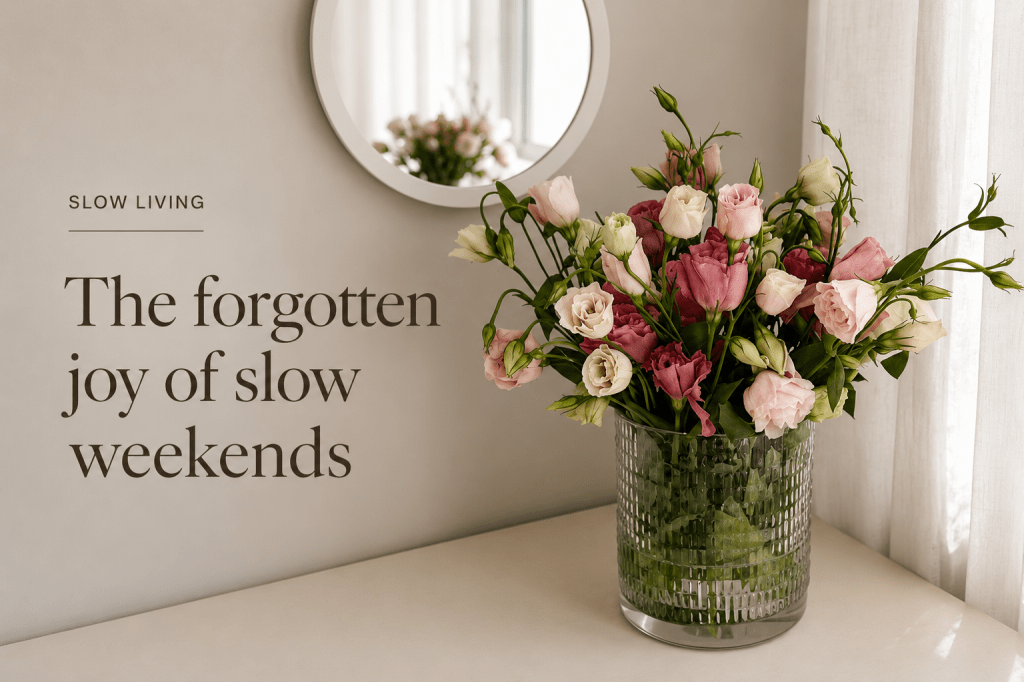
After weeks of filling every weekend with plans, I accidentally discovered the joy of having none. What began as a weekend that felt unproductive became a reminder that rest doesn’t have to be earned. Sometimes the most meaningful weekends aren’t the ones spent chasing experiences, but the ones that leave you feeling like yourself again.
It’s almost Friday.
By now, many of us are already thinking about the weekend. Maybe you’ve messaged a friend about coffee, started looking at restaurants, or suggested a day out with the family. After five busy days of work, errands, school runs, and everything else life quietly asks of us, the weekend begins to feel like something that should be filled.
I’m exactly the same.
By Thursday evening, I’m usually thinking about where we could go. We could drive into the city, wander through a bookstore, try a new café, meet friends for lunch, or find somewhere to take my daughter. I genuinely enjoy those weekends, and some of my favourite memories have come from spontaneous road trips or long conversations over coffee. Somewhere along the way, though, I also started believing that a good weekend was a busy one.
Then, two weekends ago, we didn’t have any plans.
If I’m honest, that made me surprisingly uncomfortable. By Saturday morning, I was already wondering whether we should organise something after all. Surely we shouldn’t spend the whole weekend at home. We could go for lunch, watch a film, visit the shopping mall, or simply drive somewhere for the sake of getting out of the house. I found myself scrolling through my phone, almost looking for a reason to leave.
Looking back, I don’t think I was bored.
I think I had forgotten how to rest.
Somewhere between busy workweeks and carefully planned weekends, I’d started treating free time as something that needed to be productive. If I wasn’t working, I should be exploring. If I wasn’t exploring, I should be catching up with friends. If I wasn’t doing either, I felt as though I was wasting the weekend.
In the end, we stayed home.
We made homemade pizza, watched films, and I finally picked up the book that had been waiting patiently on my bedside table. My daughter drifted between playing, drawing, and joining me in the kitchen while we made coffee in the afternoon simply because we felt like it. The windows stayed open, there was nowhere we needed to be, and the day unfolded without either of us looking at the clock.
There was no traffic to sit through, no rushing to get ready, no wondering where to park, and no conversations competing with the noise of a crowded café. Instead, there was the familiar rhythm of home; the kind you rarely notice until you slow down enough to hear it. It reminded me that a beautiful day doesn’t always begin with leaving the house. Sometimes it begins with staying exactly where you are.
By Sunday evening, I realised the guilt had disappeared. I wasn’t wishing we’d gone somewhere else or feeling as though we’d wasted the weekend. Instead, I felt something I hadn’t expected after doing so very little.
I felt rested.
It reminded me of something I explored in 30 Things to Stop Apologizing for After 30. We often think of apologising as something we do with words, but sometimes it appears in quieter ways. We apologise for declining an invitation because we’d rather stay home. We feel guilty for saying no to drinks after a long week. We convince ourselves we should accept every lunch, every gathering, and every opportunity because choosing ourselves somehow feels selfish.
Perhaps it isn’t.
Perhaps there is nothing wrong with wanting an afternoon that belongs entirely to you. One spent reading while the rain taps against the windows, making pizza from scratch because there’s nowhere else to be, sitting in the garden with a cup of coffee, watching an old film, taking an afternoon nap, playing board games with your children, baking something you’ve been meaning to try, or simply doing nothing in particular.
Modern life has a remarkable way of convincing us that every free moment should be optimised. If we aren’t answering messages, we’re checking emails. If we’re not working, we’re consuming content. Even our downtime is interrupted by notifications, algorithms, and an endless stream of things competing for our attention. Silence has become something we instinctively reach to fill, and perhaps that’s why slowing down can feel strangely unfamiliar at first.
In Why Your Thirties Might Be the Most Transformative Decade of Your Life, I wrote about how this stage of life often changes the questions we ask ourselves. We become less interested in what looks impressive and more interested in what genuinely feels good. The same shift has quietly found its way into my weekends. I’m no longer asking how much I can fit into two days. I’m beginning to ask what will leave me feeling rested when Monday arrives.
Maybe making the most of a weekend isn’t about doing more.
Maybe it’s about creating enough space to enjoy the life you’ve already built.
As I’m writing this, another long weekend is just around the corner here in Sri Lanka, and I still don’t know what we’ll do. Maybe we’ll head into the city or meet friends for lunch. Or maybe we’ll stay home again, make another pizza, spend a few hours reading, and let the day unfold exactly as it wants to.
For the first time in a long time, I’m not in a hurry to decide.
I think I’m going to sit with that feeling.
Perhaps we’ve become so accustomed to the constant pace and seamless distractions of modern life that we’ve forgotten how satisfying ordinary weekends can be. The kind where the biggest decision is whether to make another cup of coffee, read another chapter, or wander into the garden just before sunset.
Maybe it’s time to rediscover some of those old-fashioned pleasures. The ones that don’t ask us to buy a ticket, make a reservation, or post a photograph. The ones that simply ask us to be present.
I think I’ll make a list.
And if it turns out to be worth sharing, I’ll bring it here.


