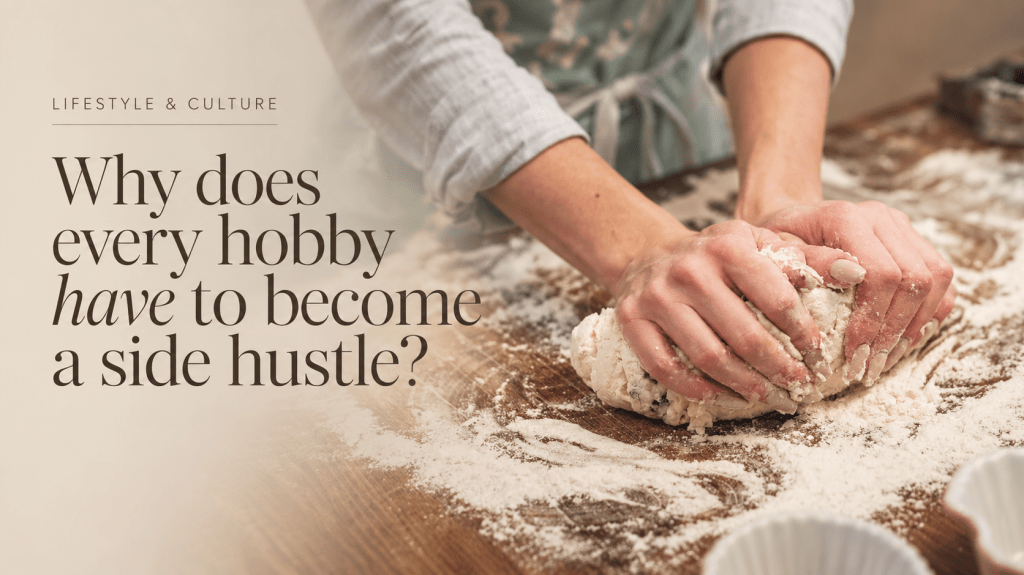
Some of the world’s greatest books, songs, paintings and businesses began as hobbies, and the world is undoubtedly richer because people chose to share what they loved. But not every hobby needs to become a career, a side hustle, or a personal brand. Sometimes the greatest value lies in creating simply because it brings you…
In this article
In recent years, the way we talk about hobbies has changed.
What once was simply a source of joy, curiosity, or relaxation is now often treated as untapped potential. The rise of side hustles and the creator economy has blurred the line between leisure and labor, making it harder to separate creativity from productivity. Against this backdrop, hobbies are rarely seen as “just hobbies” anymore.
Josef Pieper, in Leisure: The Basis of Culture, warned of the danger of “total work,” a society where human worth is measured only by productivity. In such a culture, leisure is dismissed as idleness, when in fact true leisure is an openness of the soul, a condition that allows for contemplation, culture, and connection. Lewis Hyde, in The Gift, adds that creativity thrives in a gift economy, where value flows through sharing and inspiration rather than monetary exchange. When hobbies are forced into productivity, both leisure and the gift are diminished.
This shift raises an important question: must every hobby be monetized? Exploring how monetization reshapes the creative process, the hidden expectations behind the creator economy, and the value of keeping some pursuits private, we can begin to rethink what creativity is really for.
The growing pressure to turn hobbies into income
It often begins with a compliment. Someone tastes the sourdough you have been perfecting and says, “You should sell this.” A friend admires the photographs you took on holiday and asks if you have ever thought about shooting weddings. You mention you have started painting again, and before long someone suggests opening an Etsy shop or building an Instagram page. What starts as encouragement quickly becomes expectation: if you are good at something, surely you should monetize it.
This mindset reflects a broader cultural shift. Over the past decade, side hustles have become not only common but celebrated. Platforms like Etsy, Instagram, and TikTok have made it easier than ever to turn hobbies into income streams. The rise of the creator economy has blurred the line between personal enjoyment and professional pursuit. Productivity culture reinforces the idea that time spent on a hobby should generate something tangible, whether money, followers, or recognition.
Lewis Hyde, in The Gift, warns that this shift risks reducing creativity to commodity. A work of art, he argues, is first and foremost a gift, something that circulates through inspiration, community, and shared meaning. When every hobby is pushed toward monetization, the gift dimension of creativity is stifled, leaving only the logic of the marketplace.
Josef Pieper’s critique of “total work” adds another layer. When society elevates productivity as the highest moral virtue, human worth itself is measured by output. What begins as a compliment, “You should sell this,” becomes a subtle demand that every act of leisure justify itself economically.
How monetization changes the creative process
Private creativity feels different from public creativity. When you write only for yourself, the words flow without restraint. You do not worry about polish or whether someone else will understand. The page becomes a space to think, to wander, to explore. In contrast, writing for an audience introduces a subtle shift. You begin editing as you go, anticipating how others might react. The act of creating becomes less about discovery and more about presentation.
Josef Pieper would call this private creativity a form of true leisure, not idleness but an openness of the soul that allows for contemplation and discovery. Leisure, in his view, is the basis of culture because it creates space for art, philosophy, and celebration. When hobbies are monetized, they risk being absorbed into what he called “total work,” stripped of their contemplative character and forced into productivity.
The same is true for other hobbies. Baking bread for your own kitchen is an experiment in taste and texture, but baking for customers requires consistency, branding, and deadlines. Painting for yourself allows for mistakes and unfinished canvases, while painting for sale demands polish and market appeal. Once a hobby is shared or monetized, it no longer belongs only to you.
Lewis Hyde’s The Gift offers another lens. Private creativity often operates in the spirit of the gift, circulating meaning through inspiration, family, or community. But once monetized, creativity shifts into commodity, bound by the logic of the marketplace. The gift dimension, the joy of giving freely, is diminished.
This is not to say monetization is wrong. Many people find deep satisfaction in turning their passions into professions. Sharing can bring connection, opportunity, and growth. But it undeniably changes the relationship you have with the hobby. What once felt spontaneous and joyful can begin to feel like work. The challenge is not whether monetization is right or wrong, but whether we recognize how it alters the creative process and decide consciously if that is what we want.
The hidden expectation behind the creator economy
Josef Pieper’s warning about “total work” feels especially relevant in the age of the creator economy. When productivity is elevated as the highest virtue, even leisure is judged by its ability to produce. What begins as joy risks being absorbed into work.
Over the past decade, platforms like YouTube, TikTok, Instagram, and Etsy have made it possible for millions of people to share their work, build audiences, and even earn a living from what once began as a hobby. For many, this has been liberating. It has offered independence from traditional corporate jobs, created new communities around shared passions, and allowed people to carve out careers that feel more authentic and fulfilling.
The benefits are undeniable. Writers such as Amanda Gorman have reached global audiences through self‑published and digital platforms. Artists like Beeple have built loyal followings and sold their work directly to fans. Musicians from Chance the Rapper to Billie Eilish have bypassed traditional record labels to share their songs online. The creator economy has democratized opportunity in ways that were once unimaginable.
Yet hidden within this success story is a subtle downside. The cultural narrative suggests that if you are good at something, you should monetize it. Enjoyment alone no longer feels like enough. A sketch in a notebook, a loaf of bread baked for family, or a dance practiced in the living room is seen as incomplete unless it is shared, sold, or scaled. Lewis Hyde, in The Gift, takes this concern further by showing how creativity itself changes when forced into commodity. In a gift economy, value circulates through inspiration, generosity, and community. In a market economy, value is reduced to price and profit. The creator economy, for all its opportunities, risks collapsing these two spheres into one, leaving little room for creativity that exists simply to be given or enjoyed.
Why keeping hobbies private matters
Not every sketch needs to be framed. Not every recipe needs to become content. Not every dance step needs to be performed. Some hobbies are most valuable when they remain private, existing only for the person who created them.
Keeping a hobby for yourself is not about hiding it. It is about protecting its authenticity. A sketch in a notebook, or a journal entry written late at night can hold meaning even if nobody else ever sees them. These private acts of creativity allow us to explore freely, without the pressure of performance or the expectation of productivity.
Lewis Hyde’s reflections in The Gift remind us that creativity thrives when it circulates like a gift, moving through relationships and meaning rather than price. A recipe cooked only for family or a sketch kept in a notebook belongs to this gift economy, where value is measured in connection rather than profit. Josef Pieper, in Leisure: The Basis of Culture, complements this by showing that culture itself springs from leisure, from the openness and surplus of time that lets us create without utility in mind. Together, they suggest that private hobbies preserve both the spirit of giving and the spirit of leisure, protecting creativity from being reduced to productivity.
The value of private creativity lies in self‑discovery. It gives us space to experiment, to make mistakes, and to contradict ourselves without consequence. It nurtures mental health by offering a quiet refuge from the demands of work and social media. It reminds us that creativity is not only about output but about process.
Hobbies can be meaningful even if they never leave the living room, the kitchen, or the notebook. Their worth is not measured by likes, sales, or recognition. Sometimes the most important audience is ourselves, and the act of creating becomes its own reward.
A healthier way to value creativity
The healthiest relationship we can have with creativity is one that allows for both possibilities: a hobby can grow into something bigger, but it never has to. Monetization is valid. Sharing your work with the world can be deeply rewarding. It can bring connection, opportunity, and even financial independence. Many people have built meaningful lives by turning their passions into professions, and that path deserves respect.
But it is equally important to honor the value of hobbies that remain personal. A sketch that never leaves your notebook, a recipe you cook only for family, or a dance you practice in your living room can be just as meaningful. These private acts of creativity remind us that joy, curiosity, and self‑expression are reasons enough to keep showing up. They do not need to be justified by productivity or profit.
Both Josef Pieper and Lewis Hyde remind us that creativity loses its deepest meaning when reduced to productivity alone. Pieper shows that leisure is not simply rest from work but a celebration, a condition of the soul that opens us to contemplation and culture. Hyde adds that creativity thrives when it is treated as a gift rather than a commodity, circulating through relationships and meaning rather than price. Taken together, their arguments highlight that the health of both individuals and society depends on protecting non‑commercial spaces for creativity. Leisure and gift are two expressions of the same truth: creativity flourishes when it is free, celebratory, and shared in ways that honor meaning rather than market value.
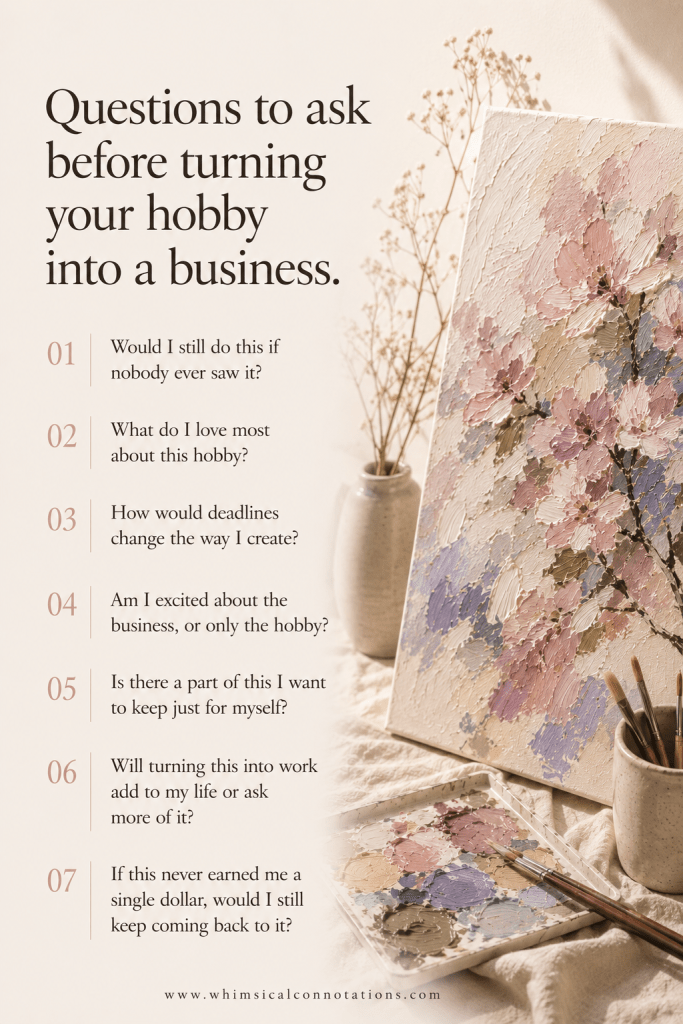
The true worth of a hobby lies not in what it becomes, but in what it gives back to us. It can offer peace after a long day, clarity in moments of confusion, or simply the pleasure of making something with our own hands.
In the end, the question is not whether one must monetize a hobby or not, but whether we allow creativity to remain meaningful even when it is not productive. Hobbies deserve the freedom to grow into careers if that is your dream, but they also deserve the right to stay small, private, and joyful.
Perhaps the deeper invitation is to rediscover whimsy in our creative lives, to let hobbies remain playful, curious, and even a little impractical. In a culture that prizes productivity, whimsy itself becomes resistance: a reminder that joy and imagination are valuable even when they serve no purpose beyond delight.
Further reading
If this reflection has piqued your interest, I highly recommend exploring Leisure: The Basis of Culture by Josef Pieper, The Gift by Lewis Hyde, and How to Do Nothing by Jenny Odell. Each offers a different lens on creativity, leisure, and the value of resisting productivity culture.
A few others to check out could be:
- The Art of Stillness by Pico Iyer, a meditation on slowing down and finding meaning in quiet moments.
- Daily Rituals: How Artists Work by Mason Currey, which reveals the private routines that sustain creative lives.
- Flow: The Psychology of Optimal Experience by Mihaly Csikszentmihalyi, a classic exploration of joy, immersion, and the state of creative flow.
Together, these books form a constellation of ideas that echo the themes of leisure, gift, and whimsical creativity. They remind us that hobbies and creative acts are not only about productivity but about presence, imagination, and the quiet joy of making something for its own sake.


